Total Pageviews

Saturday, July 16, 2011

Journey's End

This is my last blog post from El Salvador for awhile. Once I return home I will blog more as I reflect on this year's trip. I hope also to get more posts from this year's participants.
This has truly been a remarkable journey. Living with the families of San Jose las Flores was transformative. There is no other word to describe this.
We have learned so much. We have written about some of what we have been taught, but there is so much we experienced sharing in the lives of these wonderful people that still needs to be voiced.
Now on to Guatemala to work on my brutal Spanish!
Photo
The wonderful beach at Costa del Sol in San Vincente. Our last stop before home and other adventures.
Sent from my iPhone

Staying with Sister Peggy

This morning we woke up to the beautiful inner court yard of Sister Peggy's hostel. Sister Peggy is an American nun who has lived in Suchitoto for 25 years. She lived through the war in one of the areas most brutally affected by the fighting.
Suchitoto was one of the centers of the resistance. Over 1000 civilians were killed in a number of massacres that took place in the surrounding countryside.
Sister Peggy was part of a group of nuns that helped resettle refugees that had lived in church compounds for years In San Salvador. The hostel we stayed in is an abandoned school that has only recently been restored. Like much of the country, they are still rebuilding.
Each encounter is like peeling another layer off an onion. Our encounter with the sister was brief, but it leaves more questions. She talked briefly about the issue of youth and those who continue to leave the country for better opportunities in the North. She talked about the lack of students in the schools. She worries about the impact of the gangs and what the new Plan Pueblo Panama road will do to communities like San Jose Las Flores.
Another layer and more to learn.
Photo
Sent from my iPhone

Friday, July 15, 2011

In Suchitoto

We have moved on to Suchitoto today. We met with PROGRESO the local arm of CRIPDES and CORDES. The organization here is very strong. SALVAIDE our partner organization also funds projects here as does CIDA. Their work for women and youth is very progressive and they have done a significant amount of work on ecotourism initiatives.
The city of Suchitoto is beautiful. We met a 92 year old women who still practices the art of making Salvadoran cigars. She let me make one, but it didn't measure up to the wonderful ones she produced for us. Here in this picture you can see the church that dominates the central square. Tonight the square will come alive with music, dancing and fireworks as the town celebrates it's 137th anniversary.
We will be there!
Photo
Sent from my iPhone

Thursday, July 14, 2011

Day at the Sumpul

Today we spent the day at the Sumpul ecotourism spot. All the teachers who we worked with for the last week and their families came with us for a day at the pool.
We had a terrific BBQ put on by Nelson and our translator Koki. Here you can see a few of the folks after lunch.
The highlight for me was sitting, throwing stones in the Sumpul. Interesting that such a tragic place can also be the scene of a perfect ending to a memorable week.
Photo
Sent from my iPhone

Wednesday, July 13, 2011

School in the forests

Today was the last day of formal sharing sessions. The focus for our last day was on popular education. Vilma started this session off by continuing a story she had started earlier on schooling during the war.
Between 1980 and 1986, the people who remained in this area hid in the forests to avoid the army patrols. These people had very little and they had to be ready to flee at a moments notice.
Vilma became a teacher at 12. Her future husband started teaching at 11. There were 25 kids to teach from all grades. The objective was to ensure that all kids could read and write.
Children used sharp sticks to write with and flat stones to sit on. They learned the significance if words like guerra.
The kids were well behaved. To make too much noise would attract army patrols. The parents helped by digging trenches the students could drop into when the planes came.
To illustrate the school in the forests, the Salvadoran teachers did an incredible thing. They did a role play of a class in the woods including a mock attack by the army. They used fire crackers to mimic the sound if bullets. Their drawings were pictures of helicopters shooting people.
All these people were raised in similar schools. Their commitment to teaching and learning is profound.
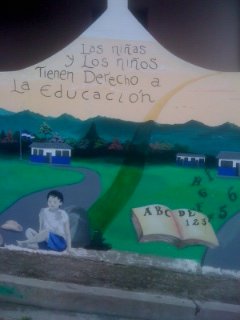
Photo
A street mural in San Jose Las Flores
Sent from my iPhone

Tuesday, July 12, 2011

Katie and Susan teach English

At this point in our stay there are a whole variety of things to do each afternoon. Today we were going to go for a hike, but it is way too hot. So one of the teachers, Salvatore invited us to observe his grade 9 English class.
Then the great idea- why not teach the class! Katie and Susan quickly put together a lesson on present and past simple tense.
Here is Susan at the white board in Salvatore's class. Another great unplanned encounter.
Photo
Sent from my iPhone

La Represion

At some point, the repression has to be addressed. In 1980, over 600 women, children and men were slaughtered in this area. It is called the Sempul River Massacre and every teacher lost family members during this time. I asked the question during one if our sessions " how do you deal with the massacre." The answer turned into an hour and a half session where each teacher spoke of great loss. We are still trying to figure out how best to convey the feeling of that session. I don't know if we can do this. Several of the Salvadoran teachers broke down during the retelling of the stories. Two of the teachers could not say anything.
These stories are over 30 years old, but the pain exists. They all have nightmares, they sometimes flinch when a plane or helicopter flies by. In their dreams they see dead people. The mourn for the family members they have lost.
In El Salvador, family is everything. Cousins, aunts, uncles, brothers and sisters are together all of the time to celebrate or just to be together. Maybe this is one of the reasons this is such a strong community. Everyone has lost their family, the community has become the family, they all share in the collective loss.
Photo
Sent from my iPhone