

What to do with an Immersion Experience?
I went on my first trip to the Dominican 16 years ago. There is no question that this was an experience that changed the way I looked at the world. You hear people say that all the time, but what does this mean?
I think immersion trips can give you a new lenses to look at the world. You live your life seeing things a certain way and then all of this world view is upset when you realize that the world is not really the way you have experienced it.
I like the analogy of head, heart and hands or see, judge act – whichever way you put it, your immersion experience is a personal conversion – don’t let anyone tell you the experience will be like this or that – it is a personal experience. The conversion will lead you to a different world view. What I think it really important is what you do with that conversion.
This is where the ‘judging’ comes in, or the heart – you have seen what the majority world looks like, so what are you going to do with that new information? What are you motivated to do with all this? Whatever it is, and there are many ways to act on your knowledge, the change that you want to see happen should take place up here, in the North.
One thing I would suggest is that you read a lot once you return – try to put together why things are as you see them. What is there such grinding poverty and why do we allow this poverty to exist. Why is there so much destruction and misery in Haiti a year after the earthquake? So, educate yourself, then look for ways you can change the structures that exist in the North that allow this imbalance to continue. Try to find ways to ask difficult questions and earn to be critical of a world that benefits from this inequality.
Think about social justice – do charity. Make sure that you can keep both going when you act. Acting or ‘hands’ is the last part of all this. You have seen the world, you are learning to reach conclusions, now, what are you going to do with all of this? Sure, charity work will always be important – the people of Haiti need new homes, schools and real employment and healthcare. But you are going to have to ask yourself – why does this happen in Haiti, in the Dominican Republic, in El Salvador and in so many parts of the Global South. Where is the justice in all the poverty that exists – what do we who benefit from so much in the world going to do to right the balance?
That can easily take a lifetime to answer – just make sure you act as well as ask.
Monday, January 24, 2011


Friday, January 14, 2011
The interesting work begins
For the past six months, we have been working on promotion. All this in an effort to get a group of teachers to come with us this summer. We are now working on program development. This is the really creative phase!
Basically, the schedule looks like this:
day 1-5 - arrival in El Salvador, orientation and visiting sites of importance in San Salvador.
day 5 - 11 - Stay in Chalatenango, working with CCR and teacher co-op
Day 11 - 14 - Beach Day and return to San Salvador for further travel or return home.

What I am really interested in right now is day 5-11. This part of the program is largely undefined - which is great! Teachers Without Borders and CRIPDES (Nelson) are working on ideas for this section - but I really want your ideas. What would be good for this week - participants, what would you like to do and explore? Former participants - based on your experience, what do you think we should be doing?
Here are some of my ideas

1. A workshop on popular education methods hosted by Equipo Maiz - a day-long experience where Canadian and Salvadoran teachers can learn and share together.

2. Exploration of the issue of mining - Canadian mining companies really want to open this area up to mining - lets explore community attitudes on this issue

3. Extended history lesson on San Jose Las Flores - this is a really interesting community that was deserted during the war and resettled while the conflict still raged - this history has created a vibrant community.
That's a start
What are your ideas??
Sunday, January 9, 2011
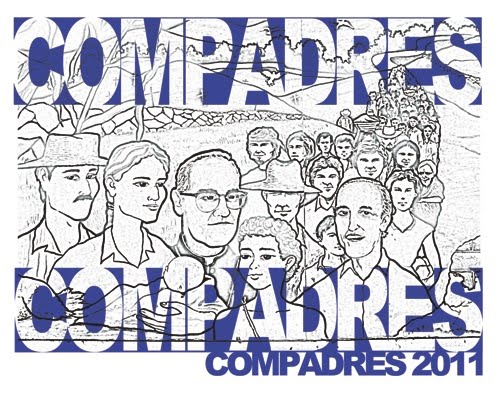
what does Compadres 'look' like?

What is Compadres? This wordl is interesting and says lots about what is important for Compadres right now.
Saturday, January 8, 2011
Conference & Discussion “Canada’s Dirty Gold Rush in Central America”
CONFÉRENCE | PUBLIC LECTURE
Ontario Public Interest Research Group (OPIRG-Ottawa) and the Ottawa-Gatineau Coalition Against Gold Mining in El Salvador present | présentent Conference & Discussion
“Canada’s Dirty Gold Rush in Central America”
Wednesday, January 12, 2011, 7:00 p.m. to 10:00 p.m. / le mercredi 12 janvier, 19h à 22h
Pavillon Fauteux (FTX), Room 147
57 Louis Pasteur, Ottawa
Guest speaker / Conférencière invitée : Nelly Rivera, Deacon of a United Church of Canada chapter partner and rep of the Centre for Research on Investment and Commerce, El Salvador / Nelly Rivera, diacre d’une chapitre associée de l’Eglise Unie du Canada et représentante du Centre pour la recherche sur l’investissement et le commerce à El Salvador
Public lecture presented in Spanish and English. Translation to French will be available. A short documentary may be presented to facilitate the discussion / Cette conférence est présentée en espagnol. La traduction à l’anglais et au français sera disponible. Un court documentaire pourrait être présenté pour alimenter la discussion.
Expanding mining capital has increased Canadian presence in Central America and also substantive damage to the environment, to human health, and numerous indigenous peoples and human rights violations in Honduras, Guatemala and El Salvador. Cerro Blanco is the name of a second large gold mine proposed by Goldcorp Inc in Guatemala near the Salvadoran border that the organized resistance of affected communities in both nations is determined to stop to prevent further damage to the environment and to indigenous/human rights and health. How is the struggle between Canada’s new dirty gold rush and Guatemalan and Salvadoran communities evolving?
This public lecture is free and open to the public. It is not required to register. For further details, please contact OPIRG opirgrc@gmail.com.
Ontario Public Interest Research Group (OPIRG-Ottawa) and the Ottawa-Gatineau Coalition Against Gold Mining in El Salvador present | présentent Conference & Discussion
“Canada’s Dirty Gold Rush in Central America”
Wednesday, January 12, 2011, 7:00 p.m. to 10:00 p.m. / le mercredi 12 janvier, 19h à 22h
Pavillon Fauteux (FTX), Room 147
57 Louis Pasteur, Ottawa
Guest speaker / Conférencière invitée : Nelly Rivera, Deacon of a United Church of Canada chapter partner and rep of the Centre for Research on Investment and Commerce, El Salvador / Nelly Rivera, diacre d’une chapitre associée de l’Eglise Unie du Canada et représentante du Centre pour la recherche sur l’investissement et le commerce à El Salvador
Public lecture presented in Spanish and English. Translation to French will be available. A short documentary may be presented to facilitate the discussion / Cette conférence est présentée en espagnol. La traduction à l’anglais et au français sera disponible. Un court documentaire pourrait être présenté pour alimenter la discussion.
Expanding mining capital has increased Canadian presence in Central America and also substantive damage to the environment, to human health, and numerous indigenous peoples and human rights violations in Honduras, Guatemala and El Salvador. Cerro Blanco is the name of a second large gold mine proposed by Goldcorp Inc in Guatemala near the Salvadoran border that the organized resistance of affected communities in both nations is determined to stop to prevent further damage to the environment and to indigenous/human rights and health. How is the struggle between Canada’s new dirty gold rush and Guatemalan and Salvadoran communities evolving?
This public lecture is free and open to the public. It is not required to register. For further details, please contact OPIRG opirgrc@gmail.com.
Partner Profile - Teachers Without Borders

Teachers Without Borders is a new adventure for us. This summer, we are hoping that we will be working with Teachers Without Borders while we are in Chalatenango google satellite maps">Chalatenango
This year our approach will be different. We have spent two years visiting communities and talking to lots of people. During these visits, we have learned a great deal and more importantly, our hosts have learned lots about us. We are now at the stage where we can focus on a community that we have visited and a group that is interested in developing sustainable links with us.
I have written about Nelson and the community support organization CCR. I want to write a little bit about TWB. I consider TWB another partner, one that can bring great value to our work. We have worked with TWB staff and have decided together that we will be developing a program that combines some of the most dynamic elements of TWB programs.
We are very interested in the teacher training tools that TWB can offer. From past conversations, teachers in El Salvador have told us that what they really want is more training. It will be great to see a program develop that will allow Canadians and Salvadorans participate in professional training and dialogue. It is still early days, but we are really looking forward to see what ideas TWB will come up with!
Thursday, January 6, 2011
Information meeting coming up

Next week - January 11, we will be meeting with teachers who are interested in taking part in the July 2011 trip.
I have made a new powerpoint presentation for this meeting - you can view the presentation at the following address:
https://www.yousendit.com/download/RlRwZFhzNDJrUmxFQlE9PQ
We are meeting at a local school - here is the information:
COMPADRES
Collective of Ontario teachers moving
for Peace, Action,
Development andRelationships in El Salvador
COME with us ON
The 2011 trip to el Salvador
To experience the beauty of The land and people
And the power of education and building links
between Ontario Teachers and communities in El Salvador
Information Meeting - January 11, 5:00PM
Vincent Massey School
745 Smyth Road, Ottawa, ON K1G 1N9
For more information:
www.compadres-elsalvador-canada.ca
613-218-9615
paul.mcguire@ottawacatholicschools.ca
Tuesday, December 28, 2010
Partner profile - Association of Communities for the Development of Chalatenango-CCR

Street mural in San Jose las Flores
A new feature of the program, this year Compadres will be working with the Association of Communities for the Development of Chalatenango-CCR. Our contact with the CCR is Nelson Orellana, the Popular Education Director for the organization. We met Nelson on our last trip to El Salvador. He is a principal in one of the schools in San Jose Las Flores and is involved in a variety of community initiatives in the Chalatenango region. Here is an excerpt from my journal entry written after our first visit to Nelson's community:
San Jose Las Flores has a thriving school community headed by Nelson, a true education innovator. Their first schools were built from the rubble of crumbling buildings. Nelson started teaching with a third grade education. His students used charcoal to write on rocks. By the end of the war, a group of teachers were able to upgrade their education and become certified. Now there is a branch of UCA, the Jesuit University in San Jose Las Flores. Over 300 students have signed up to take courses at this satellite school. Teachers now receive training in the community. This community has had a long-lasting connection with the Sisters of Ascension in Spain and from the city of Cambridge, Massachusetts through the Sister Cities Program. Linkages with groups outside the country work very well to assist the Salvadoran people to develop strong, vital communities. This is part of the social and economic rebuilding that needs to take place throughout the country. While communities like San Jose Las Flores receive a good deal of help from international donors, there is no question that the local people are the ones in control.
Nelson will be arranging part of our schedule for this year. This is very exciting - all this will be new and will finally allow us to work closely with educators in El Salvador. We will be hearing some of the specifics of what this part of the program will look like in January. I plan to blog this information as it comes out. The material that is being prepared will be uniquely fashioned to the work we want to do in the Compadres project.
Here is a little information on the CCR:
The Association of Communities for the Development of Chalatenango-CCR was founded in June of 1987 during the armed conflict in El Salvador, as an answer to the need to repopulate the communities of the North-eastern part of Chalatenango that had been destroyed by the armed conflict. Thanks to the work of the CCR the people who were exiled in the refugee camp in Mesa Grande Honduras, refugee camps inside the country and in other countries were able to repopulate the communities devastated by the war. With the signing of the Peace Accords in 1992, the CCR reoriented its work to organize and facilitate the reconstruction of the communities, and advocate that the Peace Accords be met and the process of democratization of the country move forward. Today the CCR works with 100 communities in 22 of the 33 municipalities of Chalatenango, promoting community organization and development through popularly elected community boards, legal representatives of their communities.
I believe that there is great potential here for collaboration. In my next entry, I will write about Teachers Without Borders - another new partner for Compadres.
Subscribe to:
Posts (Atom)